
Today is the last full day here in England and we will visit one of the busiest sites in the area: Stonehenge. Fortunately we had booked these tickets way beforehand, so we’re assured of entry. A ticket is for a specific time and you’re allowed in at that time or anytime fifteen minutes later. You can only image the hordes of people that make such draconian measures necessary!
We booked an early time-slot because it’s supposed to be a tad less busy, but the site is only a thirty minute drive from our cottage. We don’t have to hurry too much with breakfast, the parking lot is not yet too full and the queue at the booths not too long. First we visit the museum, showing the history of the site with artefacts and a simulation of the evolution of the site. This evolving aerial view is projected onto a huge screen and it’s really impressive to see the changes in the landscape. When people think of Stonehenge, they picture the standing stones and these are indeed the most striking element on the site. Around it are both older and new structures, some of which are still visible from the footpath to Stonehenge.
Prehistoric means that there are no written records, not that there was no civilization. These people had tools, art and respect for their dead, but because there are no written histories, it’s difficult to find out why they built these giant monuments. Recent estimates are that building Stonehenge took about thirty million hours, but a current news item on the BBC radio reports that one stone was now found to have been brought from Scotland. They might have to review their estimates again! Pig and cow bones found on site are from animals originating from many different parts of Britain, so perhaps it was an effort by multiple groups. So fascinating!


We choose the footpath to see the cursus and a few of the barrows, it’s a twenty minute walk but well worth it in my opinion. It’s sunny and warm and I’m glad I remembered to bring my Stetson summer hat. We meet the crowds when we arrive at the henge, we hear a lot of different languages and everybody’s using different brands of phones to take their selfies. Fortunately the path is very wide and with a little patience it’s possible to get a good tourist-free picture. We’ve visited before, but it is impressive every time. I could linger for hours, looking up info about the site and the prehistory in this area, but must follow the group out. I buy a new book on the way out to satisfy my addiction: The old stones: A Field Guide to the Megalithic Sites of Britain and Ireland.
It’s about noon when we’re back at the visitor center and we decide to push on and have lunch at our next stop: the Hawk Conservancy near Andover. We don’t quite know what to expect from it and are a bit taken aback at the size of the parking lot and the crowd in the restaurant. We delegate the teens to grab a free table and then join the queue to order food. It takes about forty five minutes before we can order at the counter – by this time we’re starving – and we’re still waiting half an hour later when the first demonstration is due to start. One of the staff comes over and apologises for the long wait, explaining that there’s an unexpected crowd that the kitchen is unable to handle. He proposes to pay back the meal, but also to hold the order for us until after the demonstration has ended. We get a free cookie/biscuit/crisp packet of choice to tide us over and then hurry off. By this time it’s two thirty or so.
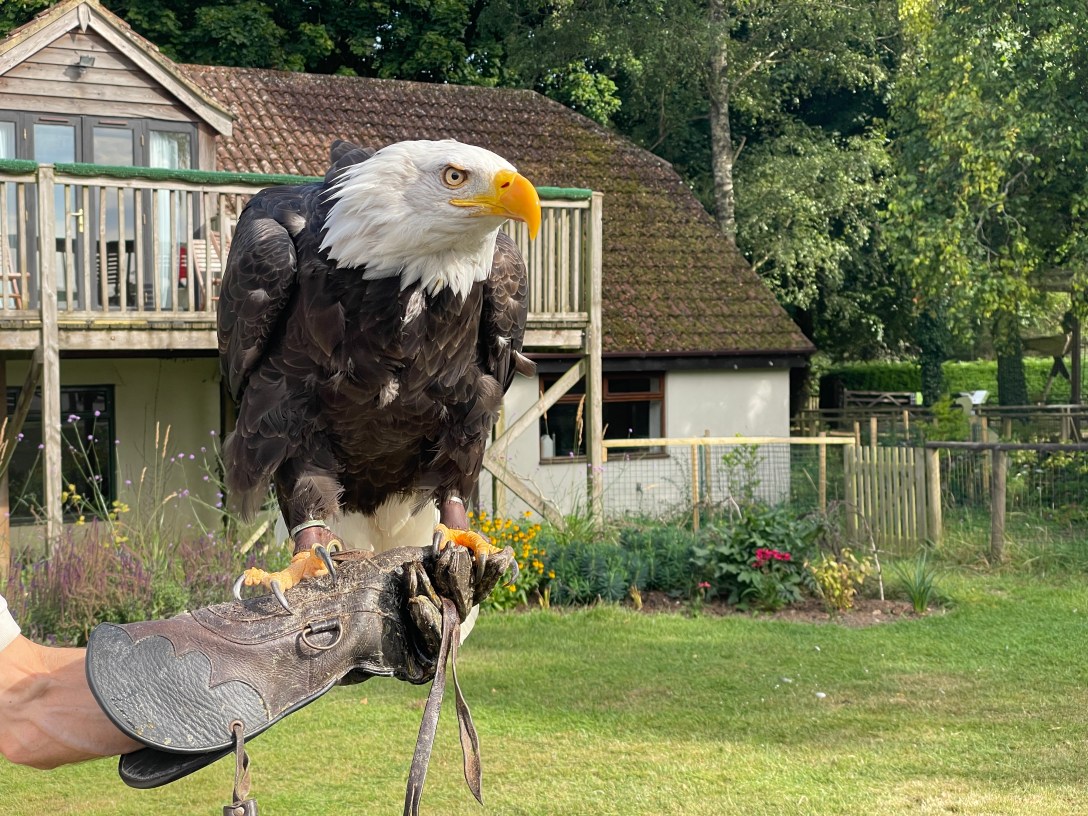
The conservancy takes in birds in need, organises demonstrations to teach people about birds of prey and also does research abroad conserving the wild population. The demonstration is both impressive to see and informative and the narrator takes care to point that for the birds this is a part of their exercise regime, as well as simply fun. We meet a Steller’s sea eagle who’s new to it and not cooperating very well, but they neatly work around it. The star Boe, an Egyptian vulture, flies up and away at the start. All the birds taking part are temporarily fitted with a GPS tracker, and the trainer lets us know from time to time how far and how high Boe’s gotten. Sometimes they have to go and collect the birds tens of miles away. The demo ends with her diving down from a height where she can barely be spotted to land neatly on the arm of the trainer.


After a break in the restaurant, where we have our free lunch, we hop back into the park for the next demonstration: owls. We sit on benches under the tree canopy while the owls, from the big Eurasian eagle-own (aptly named oehoe in Dutch) to the tiny tawny owl, fly around us. They’re completely silent because of their softer feathers and they manoeuvre nimbly through the trees, it’s beautiful to watch. Afterwards I ask a few questions of the trainer, I’ve built a nesting box for tawny owls but have been doubting whether a coat of paint is allowed. It would help preserve the wood, but the owls might not like the scent. The trainer has some good advice, but also gives me the contact info of the specialist on site, who will answer the more detailed questions.
Meanwhile I’ve called an inn to reserve a table for tonight, we’re still looking for fish and chips! Before that, there’s time at the cottage for another board game and to get a start on the packing. Dinner is delicious, but again a bit slow. I realise it’s high season, but either we’ve been unlucky or the local businesses are just not prepared for these crowds, because the food theme of this holiday has not been flavour or ingredients, but the long waiting times everywhere.
Tomorrow’s a busy day, we want to catch the train around six and will need to keep an eye on the time at our sightseeing stops along the way.
 Febe writes